
 English
Current Situation and Development of Anti-jamming Technology of GNSS
Abstract: This paper analyzes and studies the current situation and development trend of anti-jamming technology of global navigation satellite system (GNSS), studies a number of applicable and effective anti-jamming approaches including combined navigation, adaptive array antennas, new anti-jamming signal systems, region power enhancement and space-based pseudo satellite netting enhancement, and investigates the development trend of anti-jamming technology of GNSS.
0 Introduction
Satellite navigation features high positioning accuracy, short acquisition time, and all-weather global operation capability, providing humans with cheap and convenient positioning and timing information. It has been widely applied in many fields. Since navigation satellites are located approximately 20,200 km from Earth, the signal power reaching Earth is very low, making satellite navigation receiver systems highly susceptible to interference and spoofing.
The United States pioneered research into intelligent simulation environments for electronic warfare (EW) jamming in 2008, simulating interference and spoofing of satellite signals as EW threats to test the military's operational capabilities in electronic warfare. With the continuous development of software receiver technology, some research institutions have developed portable satellite navigation spoofing devices [1-2].
With the gradual establishment of China's BeiDou Satellite Navigation System (BDS), BeiDou satellite navigation receivers have begun to be equipped by the military. From a cost-effective and convenient perspective, we can learn from existing anti-jamming methods to research and explore ways to enhance the anti-jamming capability of our BeiDou navigation system. This holds significant application value for the development of China's anti-jamming countermeasure technology and also provides valuable insights for the development of our navigation system.
1 Research on Anti-jamming Technology of Global Navigation Satellite System (GNSS)
Satellite navigation system interference suppression technology has developed rapidly in recent years, breaking through many key technologies, and significantly improving the interference suppression capability of receivers. This mainly includes user receiver anti-jamming technology and navigation signal enhancement anti-jamming technology.
User receiver anti-jamming technologies mainly include improving receiver performance through extensive correlation algorithms, time-domain filtering, frequency-domain filtering, using anti-jamming antennas, and integrated navigation, etc. [3]. Navigation signal enhancement methods mainly include increasing navigation signal power, designing new pseudo-random code signals, regional navigation signal power enhancement, and pseudo-satellite technology, etc., to improve the anti-jamming capability of satellite navigation systems [4-5].
2 Navigation Receiver Anti-jamming Technology
2.1 GNSS/Inertial Navigation System (INS) Integrated Navigation Technology
GNSS/INS integrated navigation is used for precision-guided weapons or moving weapon platforms, leveraging the respective advantages of each system. GNSS navigation offers long-term stability, while INS provides high short-term accuracy, although its error accumulates over time. Using the long-term high stability of GNSS to correct the INS system reduces its drift error, improves long-term positioning accuracy, and enables in-flight transfer alignment and calibration. Utilizing the high short-term accuracy of INS, INS guidance parameters are used when GNSS is jammed. After the interference ceases, INS can assist the GNSS receiver in quickly reacquiring the navigation signal. This optimizes the entire navigation system, providing high anti-jamming capability. GNSS/INS integration can use platform velocity information provided by INS to aid the code loop and carrier loop of the GPS receiver, improving the receiver's anti-jamming capability by 10-15 dB [6].
GNSS and INS integration methods include loosely coupled, tightly coupled, and deeply coupled. These have been widely applied on various US military weapon platforms and precision-guided weapons, such as the Joint Direct Attack Munition (JDAM) and the Tomahawk cruise missile Block III, etc.
2.2 Spatial Filtering Anti-jamming Technology
GNSS receivers require antennas to receive navigation signals.
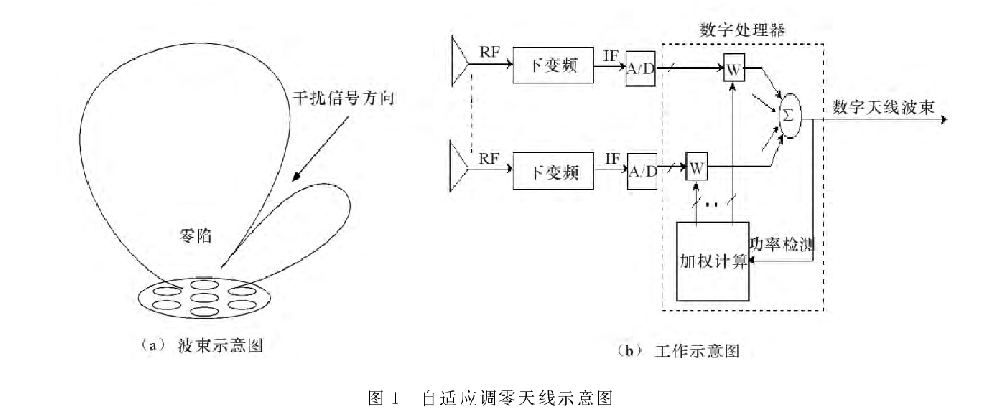
The commonly used Power Inversion (PI) algorithm for adaptive nulling leverages the characteristic that the navigation signal power is lower than the noise/interference signal power. It combines the outputs of multiple uncorrelated elements according to specific criteria to minimize the total power entering the receiver or the jammer-to-signal ratio (J/S), effectively reducing the strength of the interference signal entering the receiver [7].
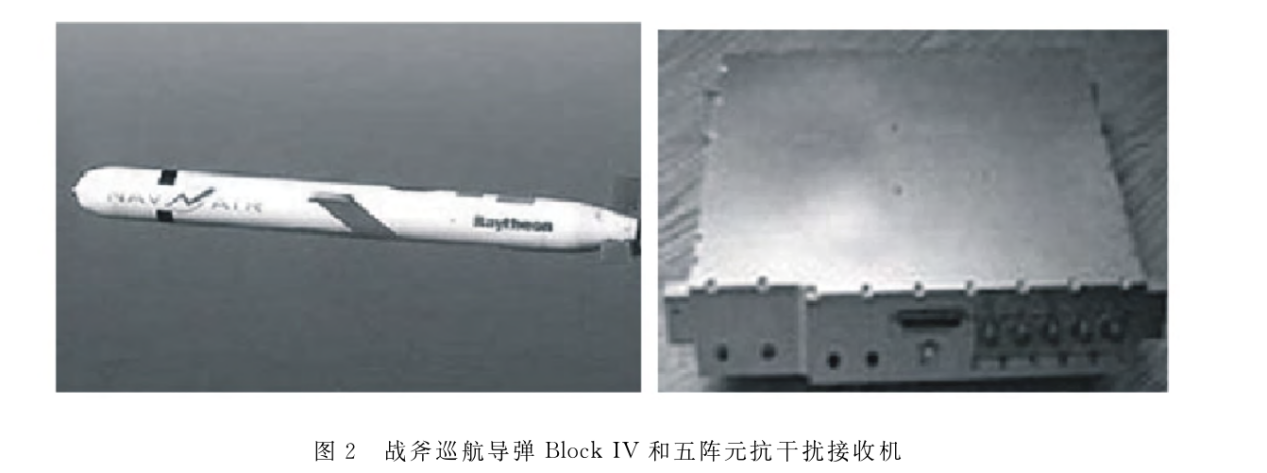
Figure 2 shows the Tomahawk cruise missile equipped with Raytheon's Anti-jam GPS Receiver (AGR). It operates in the L1 and L2 frequency bands, includes a five-element antenna array and processor, uses adaptive nulling technology to reduce interference signals, and combines beamforming technology to enhance navigation signal strength, thereby increasing anti-jamming capability [1].
Generally, using a single-element antenna with a fixed hemispherical radiation pattern provides some suppression capability against ground multipath reflection signals and low-elevation interference signals, but it is ineffective against high-elevation interference signals.
To combat and eliminate interference, spatial filtering technology based on adaptive array processing is applied to satellite navigation receiving antennas, forming adaptive nulling antennas. An adaptive nulling antenna is an antenna array composed of multiple antenna elements. It uses an adaptive nulling algorithm to weight the amplitude gain and phase shift of the signals received by each element, forming nulls (deep notches) in the direction of arrival of the interference signals, thereby suppressing the interference. The number of nulls formed is determined by the number of antenna elements; N elements can form N-1 nulls [3].
Adaptive nulling technology is a highly effective anti-jamming technique applied to most US precision-guided weapons and moving platforms. After applying adaptive nulling, the beam pattern remains largely unchanged, producing only specific nulls in the direction of the interference to reduce its signal strength, without affecting the reception of navigation signals. Figure 1 shows a schematic diagram of an adaptive nulling antenna.
2.3 Space-Time Adaptive Anti-jamming Technology
Space-time adaptive anti-jamming technology uses a multi-element array antenna, adding time-domain filtering to each element channel. It possesses strong anti-jamming and anti-multipath capabilities, offers more degrees of freedom than spatial filtering antennas, and can suppress more interference sources. A spatial filtering anti-jamming system with N elements can suppress up to N-1 interference signals. Space-time anti-jamming technology increases the degrees of freedom without adding physical antenna elements by introducing time delays to the signals received by each element. A space-time processing array with N elements and P filter taps can suppress up to NP-1 interference sources, increasing the degrees of freedom to NP-1. Figure 3 shows the structure of a space-time adaptive anti-jamming array antenna.
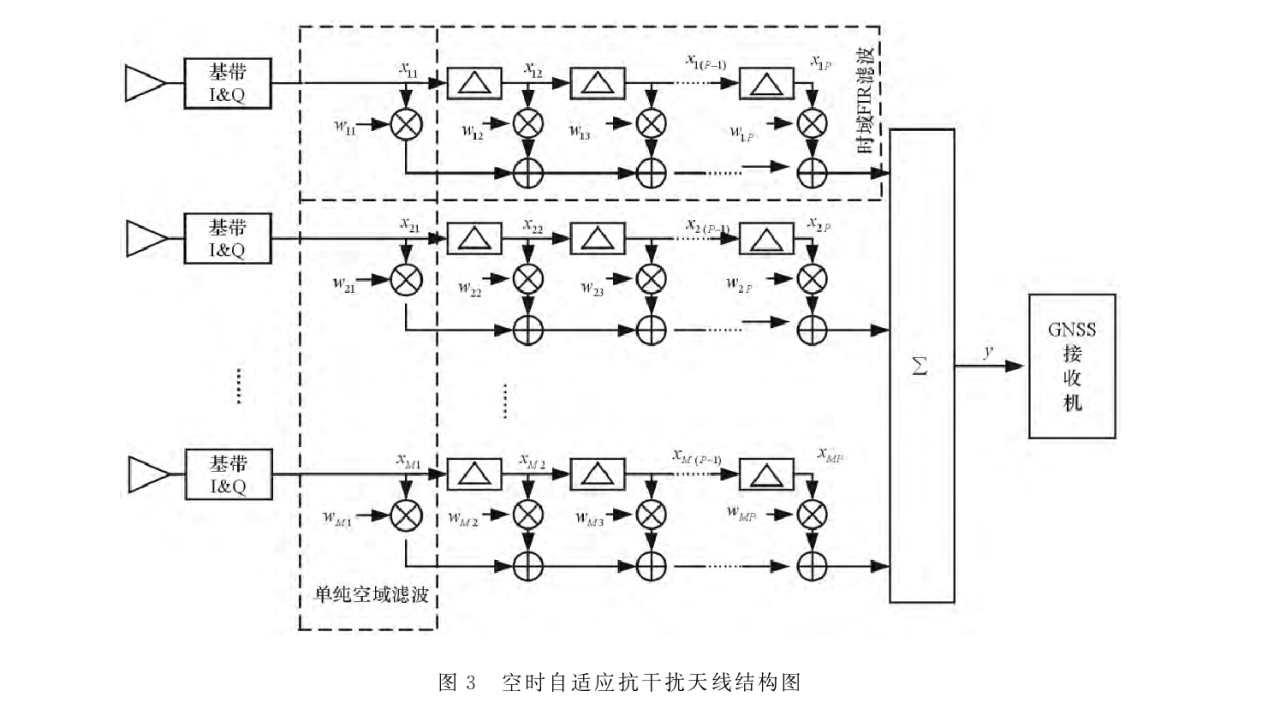
The theory of space-time adaptive filtering extends separate time, frequency, and spatial filtering into a joint two-dimensional domain of time and space, forming a combined processing approach. At the same delay time point, different elements form spatial filtering, which can determine the direction of arrival of interference signals, steer nulls towards them, and suppress the interference. From the perspective of each antenna element channel, each delay tap constitutes a time-domain Finite Impulse Response (FIR) filter, allowing analysis of the signal in the time domain to suppress interference [3, 8]. Therefore, joint two-dimensional space-time processing can distinguish useful signals from interference in a multi-dimensional space, mutually compensating for shortcomings: spatial anti-jamming technology distinguishes interference spatially and can suppress wideband interference; time-domain processing technology suppresses narrowband interference, preserves more antenna array degrees of freedom for suppressing wideband interference, and can also suppress narrowband interference arriving from the same or similar direction as the useful signal.
The miniaturized low-cost anti-jam GPS antenna (SAAGA) developed by Mayflower Communications Company in the US uses a seven-element space-time processor, capable of suppressing up to 20 interference signals, with a convergence time of less than 3 ms when suppressing 4 interference signals.
3 Navigation Signal Anti-jamming Technology
3.1 Transmitting New Navigation Signals
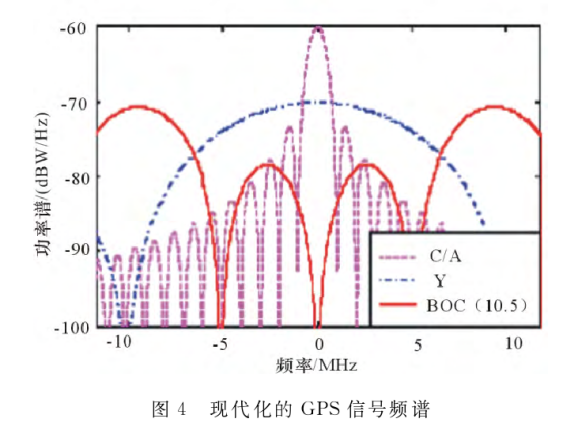
The primary anti-jamming capability of the new generation GPS system comes from the new military code signal -- the M-code. The anti-jamming performance of the M-code signal is higher than that of the P(Y)-code signal. It can be transmitted at higher power without interfering with C/A-code or P(Y)-code receivers, thereby enhancing anti-jamming capability. M-code offers more reliable signal acquisition methods compared to C/A-code and P(Y)-code, and also provides more secure key distribution. Compared to the traditional P(Y)-code, M-code offers higher accuracy and security.
The updated L1 and L2 frequencies will utilize "frequency reuse" technology, simultaneously modulating C/A-code, P(Y)-code, and M-code. M-code employs a Binary Offset Carrier (BOC) modulation scheme that places 75% of its power at the edges of the allocated bandwidth, ensuring separation in the spectrum between military and civil signals. The anti-jamming capability mainly comes from the high-power transmission, which is designed not to interfere with C/A-code or P(Y)-code reception. This is crucial and represents a strong measure by the US to maintain the superiority of its military navigation signals. The spectrum structure of the modernized GPS is shown in Figure 4.
3.2 Regional Power Enhancement Technology
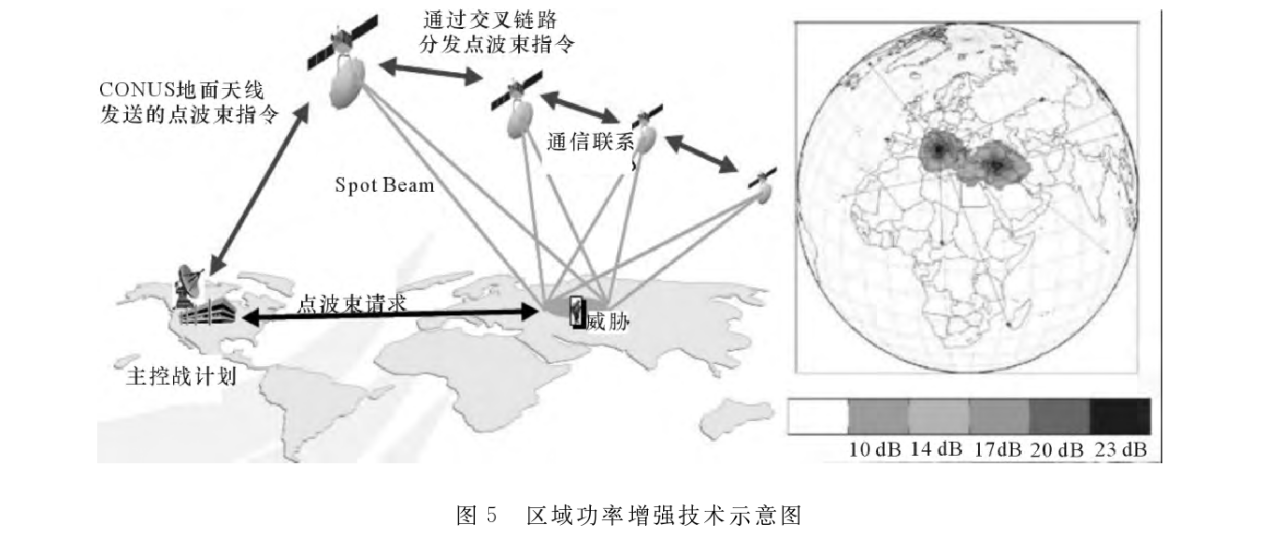
Current navigation satellites use global beam antennas, with the main lobe covering the entire Earth. Given a fixed satellite transmission power, using a narrow-beam antenna to concentrate the signal beam onto a smaller area achieves regional navigation signal power enhancement within that beam footprint (as shown in Figure 5). This typically provides a gain of approximately 20-30 dB. To jam a navigation receiver within this enhanced region, the jamming signal power would need to be correspondingly increased by 20-30 dB, thereby enhancing the anti-jamming capability. Implementing regional power enhancement technology requires support from many conditions, such as satellite attitude information, stability, narrow beam switching, and inter-satellite communication links.
Utilizing spot beam antennas to increase satellite signal transmission power is also part of the current GPS III program. Spot beams support combat areas ranging from 500 to 2,000 km, providing a gain of 20-30 dB above the standard global coverage service. Based on the actual threat requirements in a theater, a request for power enhancement is sent to the Navigation Warfare (NAVWAR) Master Control Center. The control center sets the satellite spot beam transmission power according to the threat area and the satellites overhead it. This information is transmitted to the overhead satellite via a high-speed ground antenna Telemetry, Tracking, and Command (TT&C) link. Upon receiving the message, the satellite distributes the command via inter-satellite crosslinks, enabling satellites over the threat area to activate spot beam transmission upon receiving the command.
3.3 Space-Based Pseudo-Satellite Technology
A space-based pseudo-satellite is a system placed in the air (e.g., on an aircraft or high-altitude platform) that receives signals transmitted by navigation satellites, processes the signals, amplifies them, and then re-transmits them to the ground. It consists of components such as a navigation signal receiver and transmitter. Due to its proximity to the ground, signal loss is smaller, and the navigation signal provided by the pseudo-satellite can be up to 40 dB higher than that provided directly by satellites [9]. This method can significantly enhance the anti-jamming capability of the navigation system within its service area at a relatively low cost, without requiring changes to the operation of satellites or ground stations.
The signal transmitted by the pseudo-satellite is the same as or similar to the satellite navigation signal, improving the anti-jamming performance in the local area. When the satellite navigation signal is interfered with, the stronger pseudo-satellite signal can still provide good positioning and timing services to navigation receivers.
4 Development Trends of GNSS Anti-jamming Technology
Current GNSS anti-jamming technology mainly has the following development directions:
(1) Digitization. Early anti-jamming products were primarily implemented in analog form and were bulky. Current anti-jamming processors are implemented digitally, enabling more precise interference suppression, reducing equipment size and weight. This allows GNSS anti-jamming receivers to be applied to more weapon platforms, such as cruise missiles, guided artillery shells, and other small carriers [10].
(2) Adaptive Beamforming. Adaptive beamforming antennas can generate multiple parallel, controllable beams. Each beam is steered towards a specific satellite direction to maximize the received satellite signal strength while attenuating interference signals from other directions. Although there is already extensive literature on adaptive beamforming technology, its application on moving platforms requires further research.
(3) Use of Interference Suppression Modules. Interference suppression modules consist of an antenna and an interference cancellation unit, employing signal cancellation techniques to suppress various types of interference signals. Experiments conducted in the US have verified suppression capabilities against interference types such as pulsed, continuous wave (CW), linear frequency modulation (chirp), noise frequency modulation (FM noise), and broadband noise. Suppression levels of 20 dB for wideband interference and 35 dB for narrowband interference have been achieved.
5 Conclusion
This paper discusses common anti-jamming measures for GNSS systems, including integrated navigation, adaptive anti-jamming antennas, and signal enhancement. It analyzes the future development trends of anti-jamming technology. This work can provide reference for research on GPS receiver jamming techniques and offer relevant insights for developing anti-jamming technology for China's BeiDou Global Satellite Navigation System (BDS-3).
 Current Situation and Development of Anti-jamming Technology of GNSS.pdf